
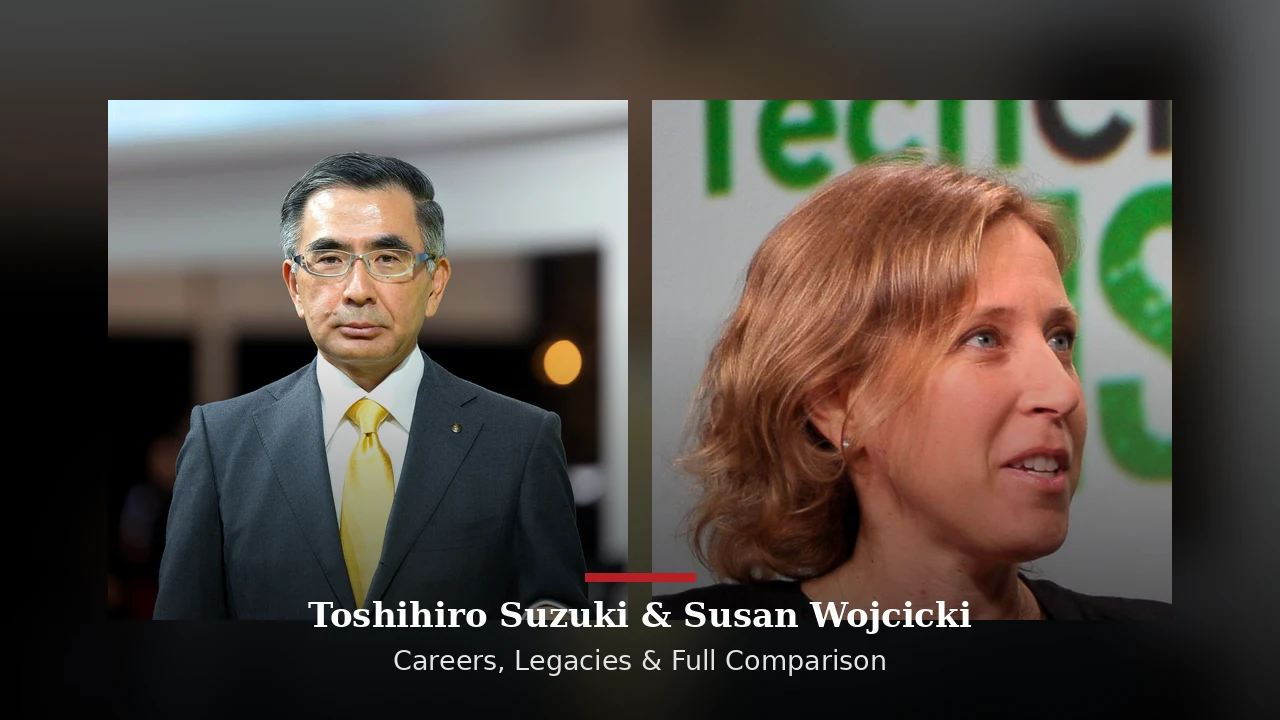
toshihiro suzuki and susan wojcicki: The Suzuki Chief and the YouTube CEO — Lives, Careers and Full Comparison
Introduction
The search phrase toshihiro suzuki and susan wojcicki brings together two quietly influential executives of the past decade — the Japanese automaker chief who steered Suzuki Motor Corporation through upheaval, and the Silicon Valley pioneer who grew YouTube into a two-and-a-half-billion-user giant. To be clear from the outset: there is no documented business relationship, partnership, or meaningful meeting between Toshihiro Suzuki and Susan Wojcicki. They worked in different industries, on different continents, and their careers never overlapped. This article exists because their names are searched together, not because they worked together.
Paired-name searches like toshihiro suzuki and susan wojcicki are a familiar online pattern, where readers compare long-tenured chief executives appointed in roughly the same era. Both took the helm in the mid-2010s — Suzuki became president of Suzuki Motor in July 2015, while Wojcicki had run YouTube since February 2014 — and both became defined by steadiness rather than showmanship. They also represent two different engines of the modern economy: heavy manufacturing in Japan and the attention economy of Silicon Valley.
Below, this profile of toshihiro suzuki and susan wojcicki gives each executive a factual mini-biography drawn only from verified public records — no rumors, no invented meetings, no fabricated net-worth figures. You will find quick-facts tables for both, Suzuki’s rise from factory floors to the presidency, Wojcicki’s path from a rented Menlo Park garage to the top of YouTube, a respectful remembrance of her 2024 passing, and a side-by-side career comparison. Readers who enjoy this kind of executive pairing may also like our earlier profile of Dilip Shanghvi and Jensen Huang, another two-leader comparison built on documented facts.
| Detail | toshihiro suzuki and susan wojcicki — Toshihiro Suzuki |
|---|---|
| Full name | Toshihiro Suzuki |
| Born | March 1, 1959, Shizuoka Prefecture, Japan (age 67) |
| Nationality | Japanese |
| Company | Suzuki Motor Corporation |
| Current role | President and Representative Director (from July 1, 2015); CEO (from 2016) |
| Education | Master’s degree, Tokyo University of Science |
| Family | Eldest son of Osamu Suzuki (1930–2024) |
| Career path | Denso → Suzuki Motor (1994) → Iwata plant head, product planning, global marketing, GM liaison (2001–2003) → Executive VP (2011) → President (2015) |
| Known as | “TS” — quiet, soft-spoken, methodical |
| Net worth | No verified figure |
Who Are toshihiro suzuki and susan wojcicki?
Toshihiro Suzuki is the president and chief executive of Suzuki Motor Corporation, Japan’s fourth-largest automaker — a company his legendary father Osamu Suzuki led from 1978 until his death in 2024 at age 94. The younger Suzuki took the presidency on July 1, 2015, after two decades climbing through the company’s factories and planning divisions, and added the CEO title in 2016 after a fuel-economy testing scandal forced his father to step back from daily control. Known inside the company as “TS,” he is a study in Japanese executive understatement: quiet, methodical, and allergic to the spotlight his outspoken father commanded. His defining challenge has been defending Suzuki’s dominance in India, where Maruti Suzuki holds over forty percent of the market, against intensifying competition.
Susan Wojcicki was one of the defining technology executives of the internet era, serving as YouTube’s chief executive from February 2014 to February 2023 — nine years in which she grew the platform to two and a half billion monthly users. Google’s sixteenth employee, she joined in 1999 after renting her Menlo Park garage to founders Larry Page and Sergey Brin for $1,700 a month, and went on to shape AdSense, Google Analytics, and Google Images before championing Google’s $1.65 billion acquisition of YouTube in 2006. She stepped down in early 2023 to focus on family and health, and died on August 9, 2024, at age 56 after a two-year battle with non-small cell lung cancer — a passing announced by her husband Dennis Troper and Google chief Sundar Pichai.
Set side by side, toshihiro suzuki and susan wojcicki illustrate how differently greatness can look at the top of a company. Suzuki inherited a family industrial dynasty and mastered the factory floor; Wojcicki helped invent the modern internet advertising economy and then ran the world’s largest video platform. One is known for saying very little; the other became a prominent public voice for women in technology.
| Detail | toshihiro suzuki and susan wojcicki — Susan Wojcicki |
|---|---|
| Full name | Susan Wojcicki |
| Born | July 5, 1968, Santa Clara County, California, USA |
| Died | August 9, 2024, aged 56, of non-small cell lung cancer |
| Nationality | American |
| Company | Google / YouTube |
| Top role | CEO of YouTube (February 2014 – February 2023) |
| Education | Harvard (history), UC Santa Cruz (economics), UCLA (MBA) |
| Family | Daughter of Stanley and Esther Wojcicki; sister of 23andMe founder Anne Wojcicki; married to Dennis Troper for 26 years; five children |
| Career path | Photojournalist in India → Google employee #16 (1999) → AdSense, Analytics, Images → championed $1.65B YouTube acquisition (2006) → YouTube CEO |
| Known for | Growing YouTube to 2.5 billion monthly users; YouTube Premium, TV, Gaming; women-in-tech advocacy |
| Net worth | No verified figure |
toshihiro suzuki and susan wojcicki: Toshihiro Suzuki’s Early Life
Toshihiro Suzuki was born on March 1, 1959, in Shizuoka Prefecture, Japan — the eldest son of Osamu Suzuki, the patriarch who transformed a small loom-and-motorcycle maker into a global automotive force during a reign that began in 1978. Growing up as heir-in-waiting to one of Japan’s most famous industrial families could have produced a dilettante; instead he took a deliberately technical path. He earned a master’s degree from the Tokyo University of Science, signaling that he intended to understand the company’s products at the engineering level rather than coast on a famous surname.
Before joining the family company, Toshihiro Suzuki spent his early working years at Denso, then known as Nippondenso, one of Japan’s great automotive parts suppliers. The choice was telling: rather than walking straight into a Suzuki corner office, he learned the supplier’s-eye view of the industry — how components, costs, and quality discipline flow up the chain. He finally joined Suzuki Motor Corporation in 1994, entering a company his father had already run for sixteen years. Starting at age 35, he would have to prove himself the long way: through plants, products, and planning rather than bloodline.
His apprenticeship years were spent where the cars actually get made. He took charge of the Iwata manufacturing facility, ran product planning and global marketing, and served as Suzuki’s liaison to General Motors from 2001 to 2003 — a posting that broadened him beyond Japan. Each assignment layered manufacturing discipline, market sense, and international exposure onto his engineering foundation. By the time succession planning entered its decisive phase, he was a tested operating executive with credentials no board could dismiss.
toshihiro suzuki and susan wojcicki: Suzuki’s Rise to President and CEO
The succession signal came in 2011, when Toshihiro Suzuki was named one of four executive vice presidents — a structure widely read as a final audition among senior leaders. Four years later he was nominated to succeed his father as president, taking office on July 1, 2015, and becoming the face of Suzuki Motor Corporation’s daily operations. The transition was framed as continuity: the same family, the same small-car philosophy, the same obsession with frugal engineering that had made Suzuki a giant in India.
Drama arrived anyway: in 2016, Suzuki admitted to improper fuel-economy testing methods, a scandal that forced Osamu Suzuki to step down as chief executive — though he remained chairman — and thrust the quiet new president into the CEO chair far earlier than planned. It was a baptism by fire, as the younger Suzuki had to stabilize the company, rebuild regulatory trust, and reassure the Indian market that had become Suzuki’s profit engine, all while standing in the shadow of a father who had led the company for nearly four decades. Those who watched him noted the contrast — where Osamu was famously outspoken and combative, Toshihiro was calm and deliberate — and inside the company, colleagues call him simply “TS.”
In the years since, the story of toshihiro suzuki and susan wojcicki’s Japanese half has been defined above all by India. Maruti Suzuki, the company’s Indian subsidiary, commands more than forty percent of the Indian car market — an extraordinary position that Suzuki himself has publicly acknowledged is under growing threat from hungrier rivals. He has spoken candidly about fighting harder for every point of share, a message reflecting both the opportunity and the pressure of the company’s most important battlefield. Meanwhile, per 2026 corporate records, he remains representative director and president — the steady hand on one of Japan’s most storied industrial companies — and no verified figure for his personal net worth exists in any reputable source, a number this profile will not invent.
toshihiro suzuki and susan wojcicki: Susan Wojcicki’s Early Life
Susan Wojcicki was born on July 5, 1968, in Santa Clara County, California — in the heart of what would become Silicon Valley — into a family of formidable intellects. Her father, Stanley Wojcicki, was a physics professor at Stanford; her mother, Esther Wojcicki, became a celebrated educator and journalist; and her younger sister Anne would found the genetic-testing company 23andMe. It was a household where curiosity was the family business, and Susan absorbed the lesson early.
Her education was elite and eclectic: a history degree from Harvard, an economics degree from UC Santa Cruz, and an MBA from UCLA. Before the tech world claimed her, she worked as a photojournalist in India — a chapter hinting at a restless, observant streak that would later serve her well in product leadership. The detour punctures the myth of the single-track Silicon Valley prodigy: Wojcicki came to Google not as a coder with a master plan, but as a broadly educated operator with a journalist’s eye for how people behave.
The most famous real-estate transaction in tech history came in 1998, when Wojcicki rented her Menlo Park garage to two Stanford graduate students, Larry Page and Sergey Brin, for $1,700 a month — the first office of a little search startup called Google. A year later, in 1999, she joined the company herself as its sixteenth employee, betting her career on a firm with no revenue and an uncertain future. It is one of the great what-if moments of business history: had she simply collected the rent and walked away, the internet as we know it would look different. Instead, she walked in — and helped build it.
toshihiro suzuki and susan wojcicki: Wojcicki’s Google and YouTube Journey
At Google, Wojcicki’s fingerprints are on nearly every product that made the company rich: she was instrumental in creating AdSense in 2003, the advertising engine that turned the web’s long tail of small publishers into a revenue machine. She also oversaw Google Analytics and Google Images, products that quietly became infrastructure for how the entire internet measures and navigates itself. Perhaps her most famous single call was championing Google’s $1.65 billion acquisition of YouTube in 2006 — a price that drew gasps at the time and looks, in retrospect, like one of the great bargains in corporate history.
In February 2014, she was named chief executive of YouTube, taking the helm of a platform already enormous and making it something larger: a global cultural institution with two and a half billion monthly users. Over roughly nine years she launched YouTube Premium, YouTube TV, and YouTube Gaming, professionalized the creator economy, and navigated bruising debates over moderation, misinformation, and copyright. She also became one of the most visible advocates for women in technology, pushing for parental leave, pay equity, and a more inclusive industry. Through it all she remained a thoughtful, data-driven leader — both the adult in the room and the visionary in it.
In February 2023, Wojcicki announced she was stepping down as YouTube CEO, handing the role to longtime deputy Neal Mohan to focus on family, health, and personal projects. The public did not know she was seriously ill; her two-year battle with non-small cell lung cancer had not been disclosed. Looking back, the decision reads as an act of characteristic grace — a leader choosing, on her own terms, to spend her remaining time where it mattered most. She died eighteen months later, on August 9, 2024, at age 56, survived by her husband of twenty-six years, Dennis Troper, and their five children.
toshihiro suzuki and susan wojcicki: Remembering Susan Wojcicki
Susan Wojcicki died on August 9, 2024, at the age of 56, after a two-year battle with non-small cell lung cancer. The news was announced by her husband, Dennis Troper, and by Google chief executive Sundar Pichai, whose tribute described her as one of the most active and vibrant people he had known. The technology world responded with an outpouring of grief rarely seen for an executive — from founders she had mentored to creators whose livelihoods she had made possible.
A note on accuracy, in the spirit this profile demands: some outlets initially reported her age as 54, but she was 56, born July 5, 1968 — a detail worth correcting because precision is a form of respect. The family-confirmed cause of death was non-small cell lung cancer, and this article will not speculate beyond what her family chose to share. She is survived by Dennis Troper, her husband of twenty-six years, and their five children, along with her parents and her sister Anne.
Wojcicki’s legacy is difficult to overstate and impossible to confine to a single company. She helped invent the economic model that funds the open web, bet early and correctly on online video, and ran the world’s largest video platform through the most turbulent decade in media history. She did all of it while advocating — persistently, publicly — for a technology industry that made room for women and for families. Hers was a life measured not in quarters but in the billions of people whose days she quietly improved.
toshihiro suzuki and susan wojcicki: Side-by-Side Comparison
Placed side by side, toshihiro suzuki and susan wojcicki offer a study in how leadership takes radically different shapes in different industries. Suzuki is a manufacturing lifer who spent two decades inside one company before inheriting its presidency from his father; Wojcicki was a builder who joined a sixteen-person startup and helped invent the products that funded the internet. He speaks rarely and softly; she became one of tech’s most prominent public voices. He defends market share in physical goods; she governed the attention of two and a half billion people.
The comparison table below lays out the documented facts without embellishment — the same standard applied to our other executive pairings, such as Mary Barra and David Cordani, which similarly compares leaders from the automotive and corporate worlds. What emerges is not a rivalry or a relationship, but a coincidence of timing: two long-tenured chief executives, appointed within eighteen months of each other, who each came to define their institutions.
| Category | Toshihiro Suzuki | Susan Wojcicki |
|---|---|---|
| Born | March 1, 1959, Shizuoka, Japan | July 5, 1968, Santa Clara County, USA |
| Status | Living (age 67) | Deceased — August 9, 2024, aged 56 |
| Nationality | Japanese | American |
| Industry | Automotive manufacturing | Technology / internet |
| Company | Suzuki Motor Corporation | Google / YouTube |
| Top role | President (2015), CEO (2016) | YouTube CEO (2014–2023) |
| Family tie | Eldest son of Osamu Suzuki | Sister of 23andMe founder Anne Wojcicki |
| Education | Master’s, Tokyo University of Science | Harvard, UC Santa Cruz, UCLA (MBA) |
| Signature achievement | Maruti Suzuki’s 40%+ India market share | YouTube at 2.5B users; building AdSense |
| Net worth | No verified figure | No verified figure |
| Documented relationship | None | None |
toshihiro suzuki and susan wojcicki: Leadership and Legacy
The leadership styles of toshihiro suzuki and susan wojcicki could hardly be more different, and the difference is instructive. Suzuki practices the classic Japanese art of the quiet executive: soft-spoken and methodical, he lets production numbers and market share do the talking while avoiding the public confrontations his father relished. Wojcicki, by contrast, paired analytical rigor with a willingness to speak out — on women in technology, on parental leave, on the responsibilities of platforms — becoming a moral as well as managerial voice in Silicon Valley.
Succession is the other great theme their stories share: Suzuki’s ascent was a decades-long, carefully staged handover inside a family-controlled company, completed — then complicated — by the 2016 testing scandal that made him CEO sooner than planned. Wojcicki’s exit was the opposite — a sudden, personal decision to step back in February 2023, with leadership passing smoothly to Neal Mohan, her chosen deputy. One succession was dynastic and public; the other was private and principled, and both companies endured — which may be the truest test of any leader: the institution outlives the individual, by design or by grace.
On the question of wealth, this profile holds a firm line that too much online content abandons: there is no verified net-worth figure for either Toshihiro Suzuki or Susan Wojcicki in any reputable source. Content farms circulate invented numbers — including a shaky “Forbes $560M” claim attached to Wojcicki that no credible record supports — and this article will not repeat them, because their legacies need no embellishment. One kept a Japanese industrial icon competitive in the world’s most demanding car market, the other built the economic and cultural infrastructure of the video internet, and that is the honest accounting of toshihiro suzuki and susan wojcicki.
toshihiro suzuki and susan wojcicki: Frequently Asked Questions
Did toshihiro suzuki and susan wojcicki ever work together?
No. There is no documented business relationship, partnership, or collaboration of any kind or consequence between Toshihiro Suzuki and Susan Wojcicki. They led companies in entirely different industries — automotive manufacturing and internet technology — on different continents, and their careers never meaningfully intersected at any point in time. Their names appear together only in online comparison content, never in any shared corporate history.
When did Susan Wojcicki die, and what was the cause of death?
Susan Wojcicki died on August 9, 2024, at the age of 56, after a two-year battle with non-small cell lung cancer. Her death was announced by her husband, Dennis Troper, and by Google CEO Sundar Pichai. Some outlets misreported her age as 54; born July 5, 1968, she was 56. The family has asked for privacy, and no further medical details have been publicly confirmed.
Who replaced Susan Wojcicki as YouTube CEO?
Neal Mohan, Wojcicki’s longtime deputy at YouTube, succeeded her as chief executive in February 2023 when she stepped down. Mohan had worked closely with her for years, including on YouTube’s product and advertising strategy, which made the handover one of the smoothest leadership transitions in recent tech history. He continues to lead the platform today, carrying forward the direction she set.
Is Toshihiro Suzuki still leading Suzuki Motor Corporation?
Yes. According to corporate records current through 2026, Toshihiro Suzuki remains the representative director and president of Suzuki Motor Corporation, roles he has held since July 2015, with the CEO title added in 2016. He continues to focus heavily on the Indian market, where Maruti Suzuki holds more than forty percent of car sales, and on steering the company through the industry’s shift toward electrification.
Was Susan Wojcicki a billionaire?
There is no verified billionaire figure for Susan Wojcicki in any reputable source. Some content farms circulate estimates — including a dubious “Forbes $560M” claim — but these are unverified and this profile does not endorse them. What is documented is that she was one of Google’s earliest employees and a central architect of products, including AdSense, that generated enormous corporate value. Her financial legacy, whatever its size, is less notable than her professional one.
Why are toshihiro suzuki and susan wojcicki searched together?
Their names are paired in online executive-comparison content because both were long-tenured chief executives appointed in the same era — Wojcicki took over YouTube in February 2014 and Suzuki became president of Suzuki Motor in July 2015. Both became known for steady, unflashy leadership of major institutions, which makes them natural subjects for side-by-side profiles. There is no deeper connection: it is a comparison of two careers, not a story about a relationship.
Conclusion
The story of toshihiro suzuki and susan wojcicki is, in the end, a story about two different definitions of leadership — and about the honesty required to tell it. One is a quiet Japanese engineer who inherited an industrial dynasty and earned the right to run it through factories, scandals, and the brutal arithmetic of the Indian car market. The other was a Silicon Valley pioneer who rented out her garage, joined a sixteen-person startup, and ran the world’s largest video platform for nine years before her death in 2024 at age 56.
If there is a lesson in pairing them, it is that greatness at the top of a company has no single accent — it can speak in a whisper from Hamamatsu or in a keynote from San Bruno. This profile has held itself to documented facts throughout: no invented relationship, no fabricated fortunes, and a respectful, accurate account of Susan Wojcicki’s passing. For readers who value that standard, our long-form profiles of Jameliz Smith and Tate McRae’s age are built the same way. And for anyone who arrived here wondering whether toshihiro suzuki and susan wojcicki ever crossed paths — now you know the truth: they didn’t, and their separate stories are remarkable enough on their own.




One thought on “toshihiro suzuki and susan wojcicki: The Suzuki Chief and the YouTube CEO — Lives, Careers and Full Comparison”