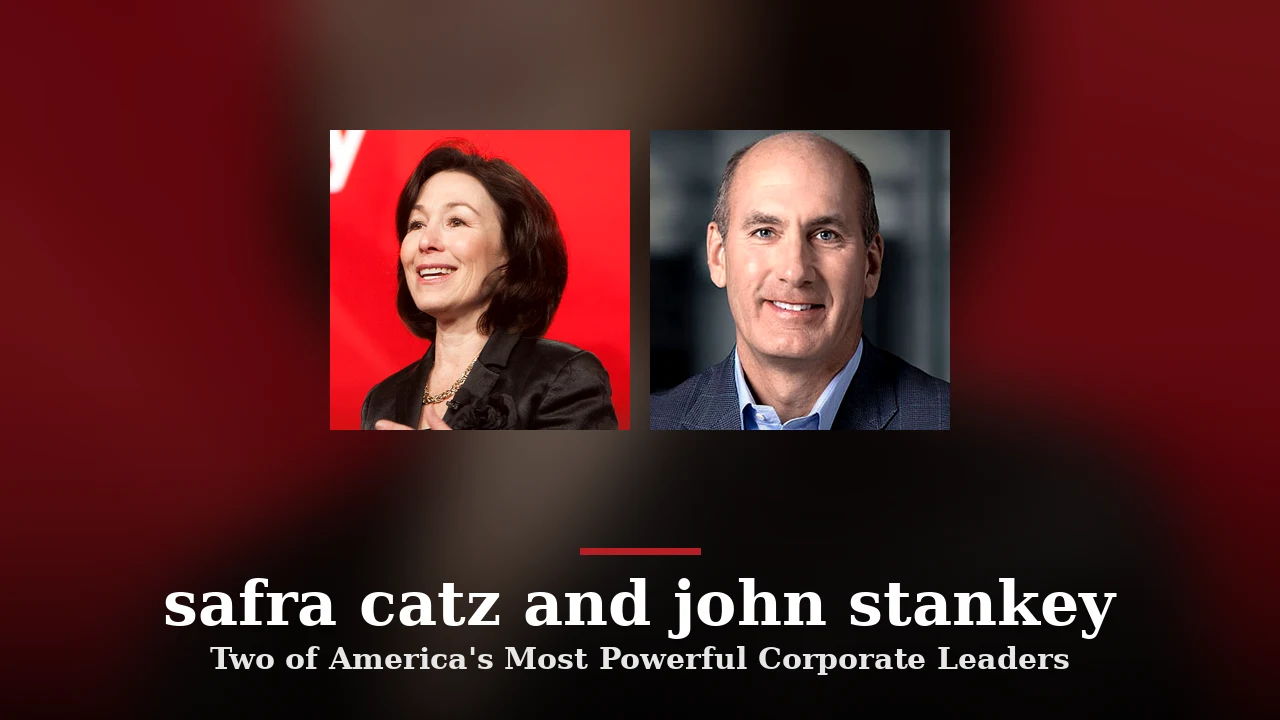
safra catz and john stankey: Two of America’s Most Powerful Corporate Leaders
Introduction
Some business leaders become famous for founding companies, while others become famous for running them better than anyone else thought possible. The story of safra catz and john stankey belongs firmly in the second category. Neither of them started the company they came to lead, yet both of them ended up defining an era for two of the most important corporations in American business history. Safra Catz spent more than a quarter of a century at Oracle, rising from senior vice president to chief executive, and along the way she became one of the wealthiest self-made women in the United States. John Stankey spent four decades inside the AT&T system, starting in an entry-level job at Pacific Bell in 1985 and eventually becoming chairman and chief executive of the entire company.
What makes the pairing of safra catz and john stankey so interesting is how much their careers rhyme with each other despite unfolding in completely different industries. Both are lifers who climbed every rung of the corporate ladder at a single company. Both came up through finance and deal-making rather than engineering or product design. Both took charge of sprawling empires at moments of genuine crisis and made enormous, controversial bets — Catz on acquisitions and the cloud, Stankey first on media and then dramatically away from it. And both have been ranked among the most powerful business leaders of their generation. This is the full professional biography of both executives: where they came from, how they rose, how they lead, and what their stories reveal about modern corporate America.
Who Are safra catz and john stankey?
To understand why safra catz and john stankey are so often discussed in the same breath, it helps to start with the simplest facts. Safra Ada Catz is an Israeli-American business executive who served as the chief executive officer of Oracle Corporation from 2014 until September 2025, when she transitioned to the role of executive vice chair of Oracle’s board. During her eleven years as CEO, she oversaw Oracle’s transformation from a traditional software vendor into a major cloud infrastructure and artificial intelligence player, and her personal fortune grew to roughly $3 billion, placing her among America’s richest self-made women.
John T. Stankey is an American businessman who has served as the chief executive officer of AT&T since July 2020 and was elected chairman of the board in February 2025. A forty-year veteran of the AT&T system, Stankey previously ran WarnerMedia, led the company’s $85 billion acquisition of Time Warner, and then — in one of the most dramatic strategic reversals in recent corporate history — unwound that very deal by spinning WarnerMedia off into a merger with Discovery. Today he leads AT&T’s refocused strategy built around 5G wireless and fiber-optic broadband. When people search for safra catz and john stankey together, they are usually looking for exactly this kind of side-by-side portrait of two parallel careers at the top of corporate America.
safra catz and john stankey: Safra Catz’s Early Life and Education
Safra Ada Catz was born in December 1961 in Holon, Israel, to Jewish parents. When she was six years old, her family immigrated to the United States and settled in Brookline, Massachusetts, where she grew up and graduated from Brookline High School. The move from Israel to suburban Boston shaped her early years, and those who have profiled her often note the discipline and work ethic that marked her from a young age. Unlike many technology executives who discovered computers in childhood, Catz showed no early inclination toward the tech industry at all.
| Quick Facts | Safra Catz |
|---|---|
| Full name | Safra Ada Catz |
| Born | December 1961 (age 64), Holon, Israel |
| Nationality | Israeli-American (U.S. citizen) |
| Education | Wharton School, University of Pennsylvania (BA, 1983); University of Pennsylvania Law School (JD, 1986) |
| Current role | Executive Vice Chair, Oracle Corporation (since September 2025); former CEO (2014–2025) |
| Spouse | Gal Tirosh (married 1997) |
| Children | 2 sons |
| Net worth | Approximately $2.9–3.4 billion (Forbes, 2025) |
For her higher education, Catz enrolled at the University of Pennsylvania, where she earned a bachelor’s degree from the prestigious Wharton School in 1983, followed by a Juris Doctor from the University of Pennsylvania Law School in 1986. The combination of elite business and legal training would become the foundation of her entire career. She has often said that for many years she planned to be a corporate lawyer, and apart from a summer internship, she never actually practiced law. Instead, the analytical rigor of both disciplines funneled her directly into investment banking, where she would spend the next thirteen years covering the software industry on Wall Street.
safra catz and john stankey: John Stankey’s Early Life and Education
John T. Stankey was born on December 19, 1962, in Los Angeles County, California, making him almost exactly one year younger than Safra Catz. He was raised in Los Angeles as the youngest of three children. His father worked as an insurance underwriter and his mother was a housewife, giving him a thoroughly middle-class Southern California upbringing far removed from the boardrooms he would one day occupy. Like Catz, Stankey showed an early aptitude for structured, analytical thinking rather than any particular passion for the industry that would define his career.
| Quick Facts | John Stankey |
|---|---|
| Full name | John T. Stankey |
| Born | December 19, 1962 (age 63), Los Angeles, California, USA |
| Nationality | American |
| Education | Loyola Marymount University (BBA Finance, 1985); UCLA Anderson (MBA, 1991) |
| Current role | Chairman and CEO, AT&T Inc. (CEO since July 2020; Chairman since February 2025) |
| Spouse | Shari Stankey (married mid-1980s) |
| Children | 3 |
| Net worth | Estimated $25–30 million (unofficial estimate; not independently confirmed) |
Stankey earned a Bachelor of Business Administration with a major in finance from Loyola Marymount University in Los Angeles in 1985, and then, while already working, completed a Master of Business Administration at the University of California, Los Angeles in 1991. The finance-first educational path mirrors Catz’s own trajectory in an interesting way: both future CEOs built their foundations on numbers, deals, and balance sheets rather than on technology itself. That shared financial DNA would later define how each of them ran their company — with a relentless focus on capital allocation, acquisitions, and shareholder returns.
safra catz and john stankey: Safra Catz’s Rise at Oracle
Before Oracle, Safra Catz spent thirteen years as an investment banker, most notably at Donaldson, Lufkin & Jenrette, where she rose to managing director covering the software industry. It was there that she first encountered Oracle as a client, and in April 1999 the company recruited her as senior vice president. What happened next was one of the fastest ascents in Silicon Valley history. Within two years she was on Oracle’s board of directors (October 2001). By early 2004 she was president of the company. In April 2011 she added the chief financial officer role, becoming co-president and CFO reporting directly to founder Larry Ellison.
Catz’s signature contribution during these years was Oracle’s ferocious acquisition strategy. She personally drove the hostile $10.3 billion takeover of PeopleSoft in 2005, a bruising eighteen-month battle that reshaped the enterprise software industry. She went on to oversee more than one hundred acquisitions, including Sun Microsystems for $7.4 billion in 2010 and NetSuite for $9.3 billion in 2016. Fortune once dubbed her “The Enforcer,” a nickname that captured her reputation for financial discipline and relentless deal execution. When Ellison stepped down as CEO in September 2014, Catz and Mark Hurd were named co-CEOs, and after Hurd’s death in October 2019, Catz became the sole chief executive.
As CEO, Catz led Oracle’s difficult pivot from traditional on-premises software to cloud computing, a transition the company entered later than rivals like Amazon Web Services and Microsoft Azure. Under her leadership, Oracle Cloud Infrastructure grew rapidly, and the company positioned itself as a prime destination for artificial intelligence workloads, signing major cloud contracts with companies including OpenAI, xAI, Meta, and Nvidia. Oracle’s market value swelled enormously during the AI boom. Then, on September 22, 2025, Oracle announced that Catz would transition to executive vice chair of the board after eleven years as CEO, with Clay Magouyrk and Mike Sicilia named as co-CEOs. She remains a director of the company she helped build into a technology giant.
safra catz and john stankey: John Stankey’s Rise at AT&T
If Safra Catz’s rise was fast, John Stankey’s was a slow-burn masterclass in corporate endurance. In 1985, fresh out of Loyola Marymount, he took an entry-level position with Pacific Bell, the California regional phone company. When SBC Communications acquired Pacific Bell in 1996, Stankey stayed on, and when SBC acquired AT&T Corporation in 2005 — taking the AT&T name for the combined company — he stayed on again. Over the decades he rotated through nearly every corner of the business: executive vice president of industry markets in 1998, president and CEO of SBC Southwest in 2001, chief information officer of the merged AT&T in 2005, chief technology officer from 2008 to 2012, and chief strategy officer and group president from 2012.
The defining chapter of Stankey’s pre-CEO career came in media. In 2018 he was named CEO of WarnerMedia, the entertainment division AT&T had just acquired through its $85 billion purchase of Time Warner — a deal Stankey himself had helped architect. He oversaw HBO, Warner Bros., Turner, and CNN, and launched the HBO Max streaming service. In October 2019 he became president and chief operating officer of all of AT&T while keeping the WarnerMedia role, and on July 1, 2020, he succeeded Randall Stephenson as chief executive of AT&T. In February 2025, the board unanimously elected him chairman as well, consolidating his leadership of one of America’s largest companies, with more than $122 billion in annual revenue and over 100 million U.S. mobile and broadband customers.
What truly sets Stankey’s tenure apart is the great strategic reversal. Having championed AT&T’s transformation into a media-telecom conglomerate, he concluded the strategy had failed and systematically unwound it: selling a stake in DirecTV to TPG Capital, and most dramatically, spinning off WarnerMedia into a $43 billion merger with Discovery in 2022 that created Warner Bros. Discovery. AT&T returned to its telecommunications roots. Under Stankey, the company has poured investment into 5G wireless and fiber-optic broadband — reaching 30 million fiber locations in 2025, acquiring most of Lumen Technologies’ fiber business for $5.75 billion, buying $23 billion of wireless spectrum from EchoStar, and committing $3 billion to closing America’s digital divide. It is a legacy built not on empire-building, but on focus.
safra catz and john stankey: Leadership Styles Compared
Comparing how safra catz and john stankey actually run their companies reveals two distinct philosophies of modern leadership. Catz built her reputation as a financial disciplinarian. Colleagues describe a leader who interrogates every number, who personally negotiated acquisition terms down to the decimal point, and who ran Oracle with the rigor of the investment banker she once was. Her eleven-year CEO tenure was defined by patience and persistence: she bet that Oracle’s database dominance and enterprise relationships would eventually translate into cloud success, and the AI infrastructure boom ultimately validated that patience spectacularly, with Oracle’s stock more than doubling in value during 2025 alone.
Stankey’s style, by contrast, is that of the pragmatic operator. Where Catz doubled down on a long-term thesis, Stankey demonstrated something rarer in corporate America: the willingness to publicly reverse a strategy he himself had championed. Admitting that the WarnerMedia experiment had destroyed shareholder value, he dismantled it methodically and returned AT&T to connectivity — wireless and fiber — with a clarity of purpose his predecessor lacked. Both leaders, however, share a common trait that explains their longevity: an almost total absence of ego about being the public face of the company. Catz rarely gave interviews and preferred working behind the scenes; Stankey is similarly understated, a career insider rather than a celebrity CEO. In an era of founder-cult leadership, safra catz and john stankey represent the triumph of the professional manager.
safra catz and john stankey: The Deals That Defined Them
No serious biography of safra catz and john stankey can avoid the deals, because deals are the language both executives speak most fluently. For Catz, the deal list reads like a history of enterprise software consolidation: the hostile $10.3 billion PeopleSoft takeover in 2005, which she drove personally through eighteen months of legal and financial warfare; the $7.4 billion acquisition of Sun Microsystems in 2010, which gave Oracle its own hardware business; and the $9.3 billion purchase of NetSuite in 2016, which accelerated Oracle’s cloud applications push. Across her tenure she oversaw well over one hundred acquisitions, each one integrated with the same financial discipline.
For Stankey, the deal history is more dramatic because it contains both the buying and the selling. As a key lieutenant to Randall Stephenson, he helped drive AT&T’s $48.5 billion acquisition of DirecTV in 2015 and the $85 billion acquisition of Time Warner in 2018 — the latter creating WarnerMedia, which he then ran himself. But as CEO, Stankey became the great unwinder: the DirecTV stake sales to TPG, and above all the $43 billion WarnerMedia–Discovery transaction of 2022 that he himself described as a necessary admission that the media diversification had failed. Where Catz’s deals built an empire, Stankey’s second act of deals dismantled one — and investors have largely rewarded him for the honesty. Readers interested in how wealth accumulates at this level may also enjoy our profile of Misha Ezratti’s net worth, another study in modern fortune-building.
safra catz and john stankey: Personal Lives and Families
Despite running two of the most scrutinized companies in America, both halves of safra catz and john stankey have kept their personal lives remarkably private. Safra Catz has been married to Gal Tirosh, a former soccer coach, since 1997, and the couple has two sons. The family resides in Fort Lauderdale, Florida. Catz almost never discusses her family publicly, and her sons’ names appear only in scattered public records. Her private nature extends to philanthropy and civic life conducted largely out of the spotlight, though her public roles have included serving on the boards of HSBC, The Walt Disney Company (2018 to 2024), Paramount Skydance (from August 2025), and as a trustee of In-Q-Tel, the nonprofit strategic investor supporting U.S. national security agencies.
John Stankey married his wife Shari in the mid-1980s, early in his career at Pacific Bell, and the couple has three children. Like Catz, Stankey has maintained strict privacy around his family; Shari is occasionally mentioned in profiles as a steadying presence through his demanding four-decade career, including a noted joint gift to Loyola Marymount University. Neither executive courts celebrity, neither maintains a public social media persona, and both are known for deflecting personal questions in interviews. In an age when many CEOs function as public brands, the private lives of safra catz and john stankey remain refreshingly — and deliberately — out of view.
safra catz and john stankey: Net Worth and Compensation
The financial dimension of safra catz and john stankey tells two very different stories about wealth at the top of corporate America. Safra Catz is a billionaire several times over. As of August 2025, Forbes estimated her net worth at approximately $3.1 billion, ranking her 15th on Forbes’ list of America’s Richest Self-Made Women, and other 2025 estimates placed her fortune between $2.9 billion and $3.4 billion as Oracle’s stock surged on AI enthusiasm. The wealth comes overwhelmingly from Oracle equity accumulated over twenty-six years, including a notable March 2021 transaction in which she converted derivatives into 2.25 million shares and sold them at roughly double the price. She was the highest-paid female CEO in America in 2016 at $40.9 million, and her 2022 total compensation reached $138 million.
John Stankey, by contrast, is wealthy by any normal standard but not in the billionaire class. Unofficial estimates place his net worth in the range of $25–30 million, derived primarily from AT&T stock holdings of roughly half a million shares and cumulative executive compensation that has exceeded $25 million per year in recent years — his 2023 total compensation was reported at $25.7 million. The gap between the two figures illustrates a real structural difference: Catz built wealth through decades of equity appreciation at a software company whose stock compounded enormously, while Stankey’s compensation reflects the steadier, dividend-oriented economics of a telecom giant. For more on how executive fortunes compare, see our paired biographies of Kobe Bryant and Patrick Mahomes and Audrey Hepburn and Michael Phelps.
safra catz and john stankey: What Connects These Two Leaders
Step back from the details, and the deeper connection between safra catz and john stankey comes into focus. Both are supreme examples of the company lifer: Catz gave Oracle twenty-six years, Stankey has given the AT&T system forty. Both rose through finance rather than product or engineering — she as an investment banker and lawyer, he as a finance major who started as a financial analyst. Both took the helm at moments when their industries were being fundamentally reshaped by technology, and both responded with enormous structural bets: Catz’s acquisition-fueled cloud pivot, Stankey’s media adventure and subsequent reversal.
Perhaps most tellingly, both leaders embody a style of American capitalism that is increasingly rare: the disciplined steward rather than the visionary founder. Neither Catz nor Stankey started their company. Neither cultivated a personal cult. What they did instead was arguably harder — they took sprawling, mature institutions and forced them to adapt, making thousand-person, billion-dollar decisions with incomplete information and living with the consequences in public. Whether history judges Catz’s cloud bet or Stankey’s fiber bet more kindly, the pairing of safra catz and john stankey will remain a defining case study in what professional management can achieve at the very top of corporate America.
safra catz and john stankey: Frequently Asked Questions
Who are safra catz and john stankey?
Safra Catz is the Israeli-American billionaire executive who served as CEO of Oracle Corporation from 2014 to September 2025 and is now the company’s executive vice chair. John Stankey is the American businessman who has served as chairman and CEO of AT&T since 2020 and 2025 respectively. Both are among the most prominent corporate leaders in the United States.
Is Safra Catz still the CEO of Oracle?
No. On September 22, 2025, Safra Catz transitioned from chief executive officer to executive vice chair of Oracle’s board after eleven years as CEO. She was succeeded by co-CEOs Clay Magouyrk and Mike Sicilia, and she remains a director of the company.
How long did it take John Stankey to become AT&T CEO?
John Stankey joined Pacific Bell in an entry-level position in 1985 and became CEO of AT&T on July 1, 2020 — a thirty-five-year climb through nearly every major division of the company, including stints as CTO, chief strategy officer, WarnerMedia CEO, and president and COO.
What is the net worth of safra catz and john stankey?
Safra Catz’s net worth is estimated at approximately $2.9–3.4 billion (Forbes, 2025), making her one of America’s richest self-made women. John Stankey’s net worth is unofficially estimated at $25–30 million, based on AT&T stock holdings and executive compensation.
Are safra catz and john stankey related?
No. Despite both being prominent American CEOs with decades-long careers at a single company, Safra Catz and John Stankey are not related to each other. They lead companies in different industries — enterprise software and telecommunications — and their pairing here is a comparison of two parallel leadership journeys.
Conclusion
The combined story of safra catz and john stankey is ultimately a story about a particular kind of American success — the kind built not on founding something new, but on mastering something enormous. Catz took a software giant through the most disruptive technological shift of its lifetime and emerged a billionaire; Stankey took a telecom giant through an ill-fated media adventure and had the rare courage to reverse course, refocusing the company on the networks that made it great. Both did it without fanfare, without a cult of personality, and without ever leaving the companies that made them. For anyone studying leadership, corporate strategy, or simply how careers are built at the highest level, these two parallel biographies offer lessons that will remain relevant long after both executives have left the stage.