
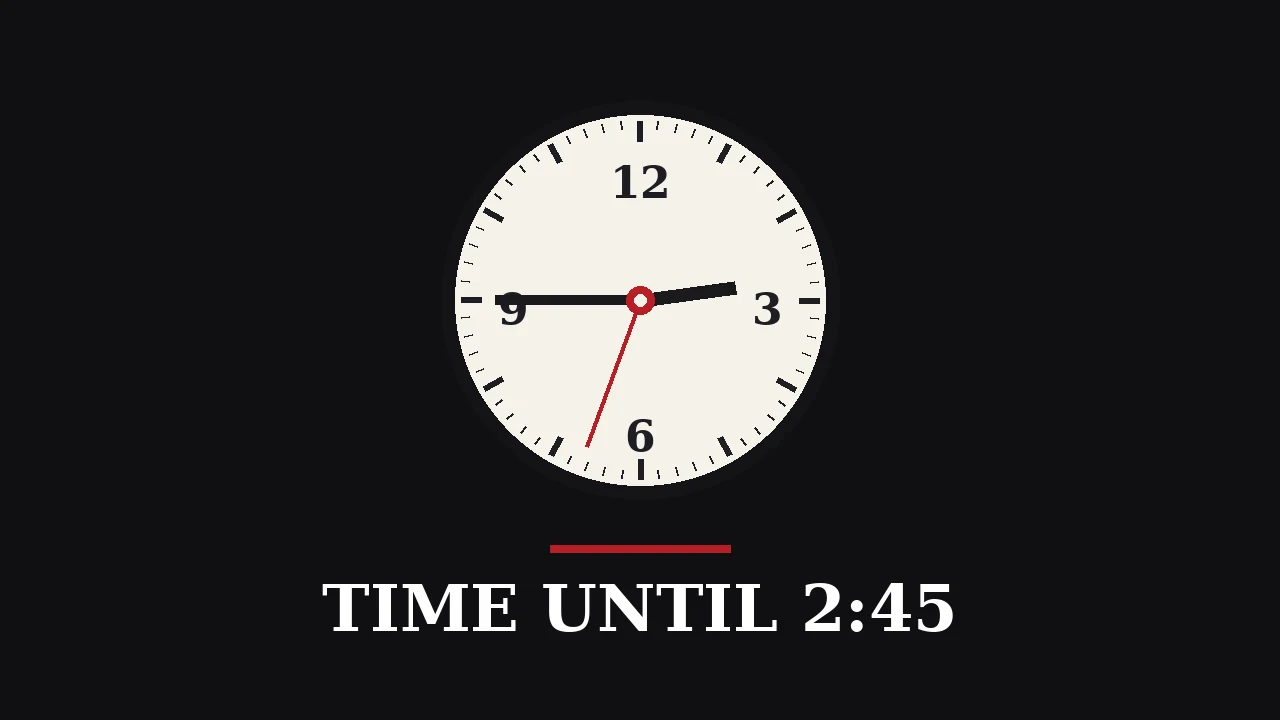
Time Until 2:45: Live Countdown, Calculation Guide and FAQs
Introduction
Searching for the “time until 2:45” usually means one thing: something is happening at 2:45 and you want to know exactly how long you have to wait. It might be a class starting, a meeting, a bus to catch, a show dropping, or an alarm you set and promptly forgot about. Whatever the reason, the answer depends entirely on the current time — which is why a static answer never quite works and why a live timer is the best tool for the job. This page gives you both: a real-time countdown to the next 2:45 that updates every second, and a full guide to calculating the time until 2:45 yourself for any moment of the day.
The timer below reads your device’s clock, finds the next 2:45 on it — 2:45 AM or 2:45 PM, whichever is coming sooner — and counts down the hours, minutes, and seconds left. Below the timer you will find the quick mental-math method, a complete hour-by-hour reference table, an explanation of the AM/PM question that confuses almost everyone, and answers to the most common follow-up questions. By the end, the time until 2:45 will hold no mysteries.
Time Until 2:45: The Quick Answer
The time until 2:45 is simply the gap between now and the next 2:45 on the clock — and since 2:45 happens twice every day, that gap is always under 12 hours. At 1:30 PM, the time until 2:45 is 1 hour and 15 minutes. At 3:00 PM, the afternoon 2:45 has already gone, so the next one is 2:45 AM tomorrow: 11 hours and 45 minutes away. The live countdown above shows the precise figure for this exact second, so for the fastest answer, just read the timer.
If you need the answer for a time other than right now — say you are planning tomorrow, or working out when to leave — the method and table below have you covered. The key idea to hold onto is that “time until 2:45” almost always means the next upcoming 2:45, and everything on this page follows that convention unless it says otherwise. Once you internalize that, the rest is simple subtraction.
How to Work Out the Time Until 2:45
The reliable way to work out the time until 2:45 in your head uses three steps. First, check the current time. Second, identify the next 2:45: if it is before 2:45 AM, that is your target; if it is between 2:45 AM and 2:45 PM, the afternoon one is next; if it is after 2:45 PM, the target is 2:45 AM tomorrow. Third, subtract now from the target. Take an example: it is 11:20 AM. The next 2:45 is 2:45 PM today. From 11:20 AM to 2:20 PM is 3 hours, plus 25 more minutes to 2:45 PM, giving 3 hours 25 minutes.
A second example shows the overnight case: it is 9:10 PM and you ask for the time until 2:45. The 2:45 PM slot passed hours ago, so the target is 2:45 AM tomorrow. From 9:10 PM to midnight is 2 hours 50 minutes; add the 2 hours 45 minutes from midnight to 2:45 AM, and the total is 5 hours 35 minutes. The overnight case is the one people get wrong most often, because it is tempting to subtract backwards and land on a negative number — whenever the target looks “earlier” than now, remember to roll forward to the next day.
For those who prefer a mechanical method, the minutes trick never fails. Convert the target to minutes after midnight: 2:45 AM is 2 × 60 + 45 = 165 minutes; 2:45 PM is 14 × 60 + 45 = 885 minutes. Convert the current time the same way. Then subtract the current minutes from the smallest target value that is bigger than them; if neither target is bigger, add 1,440 (the minutes in a day) to the 2:45 AM value and subtract from that. Divide the result by 60 for hours, and the remainder is minutes. It sounds fiddly written out, but on paper or a phone calculator it takes about fifteen seconds.
Time Until 2:45 — Hour-by-Hour Reference Table
Find your current hour below for an instant read on the time until 2:45. The table counts down to the next upcoming 2:45, AM or PM, and the third column tells you which one that is. For the exact figure including minutes and seconds, the live timer at the top is authoritative.
| If it is now… | Time until the next 2:45 | Which 2:45 is next? |
|---|---|---|
| 12:00 AM (midnight) | 2 hours 45 minutes | 2:45 AM today |
| 1:00 AM | 1 hour 45 minutes | 2:45 AM today |
| 2:00 AM | 45 minutes | 2:45 AM today |
| 3:00 AM | 11 hours 45 minutes | 2:45 PM today |
| 4:00 AM | 10 hours 45 minutes | 2:45 PM today |
| 5:00 AM | 9 hours 45 minutes | 2:45 PM today |
| 6:00 AM | 8 hours 45 minutes | 2:45 PM today |
| 7:00 AM | 7 hours 45 minutes | 2:45 PM today |
| 8:00 AM | 6 hours 45 minutes | 2:45 PM today |
| 9:00 AM | 5 hours 45 minutes | 2:45 PM today |
| 10:00 AM | 4 hours 45 minutes | 2:45 PM today |
| 11:00 AM | 3 hours 45 minutes | 2:45 PM today |
| 12:00 PM (noon) | 2 hours 45 minutes | 2:45 PM today |
| 1:00 PM | 1 hour 45 minutes | 2:45 PM today |
| 2:00 PM | 45 minutes | 2:45 PM today |
| 3:00 PM | 11 hours 45 minutes | 2:45 AM tomorrow |
| 4:00 PM | 10 hours 45 minutes | 2:45 AM tomorrow |
| 5:00 PM | 9 hours 45 minutes | 2:45 AM tomorrow |
| 6:00 PM | 8 hours 45 minutes | 2:45 AM tomorrow |
| 7:00 PM | 7 hours 45 minutes | 2:45 AM tomorrow |
| 8:00 PM | 6 hours 45 minutes | 2:45 AM tomorrow |
| 9:00 PM | 5 hours 45 minutes | 2:45 AM tomorrow |
| 10:00 PM | 4 hours 45 minutes | 2:45 AM tomorrow |
| 11:00 PM | 3 hours 45 minutes | 2:45 AM tomorrow |
The table has a pleasing symmetry: morning and evening mirror each other because the two 2:45s sit exactly 12 hours apart. If your current time is between the listed hours — for instance 1:37 PM — take the 1:00 PM row (1 hour 45 minutes) and subtract the 37 minutes past the hour, leaving 1 hour 8 minutes. With a little practice this adjustment becomes automatic, and for anything requiring precision the countdown timer does it flawlessly.
2:45 AM or 2:45 PM? Sorting Out the Ambiguity
Nearly every “time until” question hides an AM/PM ambiguity, and 2:45 is no exception. In conversation, people resolve it with context: a 2:45 lunch booking is obviously PM, a 2:45 alarm before a dawn shift is AM. But a bare search for “time until 2:45” carries no context, so the only sane default — the one this page and its timer use — is the next chronological 2:45. That convention matches what most people actually want: how long from this moment until the clock next reads 2:45.
When the specific one matters, name it. “Time until 2:45 PM” is unambiguous, and if that 2:45 PM is already past, the honest answer is the time until tomorrow’s 2:45 PM — just under 24 hours at most. Digital assistants insist on the qualifier for exactly this reason: ask Siri or Google for “time until 2:45” and you will get the next one, but ask them to “set an alarm for 2:45” and they will ask “AM or PM?” before proceeding. Adopting the same habit in your own planning — always attaching AM or PM when it matters — eliminates an entire category of scheduling mishaps.
A final edge case worth knowing: at exactly 2:45, the time until 2:45 is zero, and timers immediately begin counting toward the next one 12 hours later. If you are working to a 2:45 deadline, do not aim to finish at 2:45 — aim for 2:35. The ten-minute buffer absorbs the small frictions of real life, and it is the reason experienced planners set their alarms a little early rather than exactly on the hour they need.
Time Until 2:45 in 24-Hour Clock Format
On the 24-hour clock, 2:45 AM is written 02:45 and 2:45 PM is 14:45. If you live somewhere the 24-hour clock is standard — most of Europe, much of Asia, and professional settings like aviation and healthcare worldwide — then “time until 2:45” is really “time until 02:45 or 14:45,” and the AM/PM confusion simply does not arise. The arithmetic is unchanged: find the next of the two times that lies in the future and subtract now from it.
An example in 24-hour terms: it is 13:20 and you want the time until 2:45. The candidates are 02:45 (passed) and 14:45 (upcoming), so the answer is 14:45 minus 13:20 — 1 hour 25 minutes. If it is 16:00, both of today’s candidates have passed, so the target is tomorrow’s 02:45: 8 hours to midnight plus 2 hours 45 minutes gives 10 hours 45 minutes. Converting between formats is a one-step operation — add 12 to a PM hour to get the 24-hour form (2 + 12 = 14, hence 14:45), and subtract 12 to go back. Once that conversion is second nature, time-until questions become trivial in either system.
Time Zones: Whose 2:45 Are We Talking About?
The timer on this page uses your device’s local time, so for personal use — your alarm, your show, your appointment — time zones never enter the picture. They matter the moment a 2:45 involves someone elsewhere. A 2:45 PM call scheduled in London is 9:45 AM in New York and 6:45 AM in Los Angeles; two people asking “time until 2:45” in different zones will get different answers unless they agree on the reference zone first.
The fix is a habit: whenever a 2:45 crosses a zone boundary, attach the zone to the time — “2:45 PM GMT,” “2:45 PKT,” “14:45 CET.” Calendar invitations do this automatically, and they adjust the displayed time when you travel, which is why putting cross-zone events on a calendar beats keeping them in your head. Twice a year, daylight saving transitions add an hour of weirdness: on spring-forward Sunday the hour from 2:00 to 3:00 AM does not exist in regions that observe it, so a naive “time until 2:45” calculation spanning that gap is off by an hour. Your phone’s clock handles the jump correctly, and so does the countdown above, because both follow the device’s zone-aware time.
When you need to sanity-check a cross-zone 2:45, open your phone’s world clock, add the other city, and read the two times side by side. Then the subtraction proceeds exactly as this guide describes. Thirty seconds of checking beats an hour of apologizing for a missed call.
Never Miss 2:45: Alarms and Reminders That Work
Finding the time until 2:45 is usually preparation for not missing 2:45, so it is worth setting the safety net properly. Phone alarms are the obvious tool: open the clock app, create a 2:45 alarm, and — critically — verify the AM/PM setting before you save it. More missed appointments trace back to a wrongly-toggled AM/PM than to any other single cause. Label the alarm with its purpose (“2:45 standup”) so that when it fires you instantly know why.
For one-off events, a voice-assistant reminder or calendar event beats a recurring alarm: “remind me at 2:45 PM to join the call” creates a single, self-deleting nudge, while a calendar event puts the 2:45 in the context of your whole day. If the event is something you are looking forward to — a match, a stream, a release — a home-screen countdown widget gives you the remaining time at a glance all day, which is precisely the experience the timer at the top of this page recreates in your browser. And the golden rule of punctuality applies: set the alarm for 2:35, not 2:45. Arriving ten minutes early to your own deadline is a superpower; arriving ten minutes late is a reputation.
FAQs About Time Until 2:45
What is the time until 2:45 right now?
The live countdown at the top of the page shows it exactly — hours, minutes, and seconds until the next 2:45, refreshed every second from your device clock. The answer is always under 12 hours since 2:45 occurs twice a day.
Does “time until 2:45” mean AM or PM?
It means whichever is next. This page’s timer counts down to the next chronological 2:45. If you need a specific one, say “2:45 PM” explicitly; if that time passed today, the next one is tomorrow.
How can I calculate the time until 2:45 myself?
Subtract the current time from the next 2:45 (rolling to the next AM/PM slot or tomorrow if needed), or use the minutes method: convert both times to minutes after midnight and subtract. The hourly table above gives instant answers for every hour.
What is 2:45 in 24-hour time?
2:45 AM is 02:45; 2:45 PM is 14:45. The 24-hour format removes AM/PM ambiguity, which is why transport, hospitals, and the military prefer it.
The timer shows nearly 12 hours — is that right?
Yes. Right after a 2:45 passes (say at 2:46 PM), the next one is 2:45 AM, almost 12 hours away. The countdown always targets the next upcoming 2:45, so a near-12-hour reading just means you missed the last one.
Conclusion
The time until 2:45 is never more than a glance away: the live countdown above tracks it to the second, and the method, table, and FAQs on this page let you work it out for any moment, in any format, in any time zone. The only real trap in the whole question is the AM/PM ambiguity, and now you know how to dodge it — assume the next one, name the specific one when it matters, and keep a ten-minute buffer before anything important.
Bookmark this page if 2:45 structures your day, and use the companion timers for how much time until 3:30 and how long until 3:10 whenever the next countdown comes up.